Astronaut
21 April 201512:54PMusa-2015travel
Things I Learned At The Boston Museum of Science
-
The ASTC Passport program is wonderful, and will allow you to get into all sorts of cool places with your dinky little card from Scitech, Western Australia. Seriously, I have seen how we print these things. They are annoying special snowflake paper, on a very ordinary photocopier. They should not entitle you to meet an astronaut, much less for free - but they do, and I love them for it.
-
By comparison with museums in the UK, which are all pretty universally free, museums in the US are not just not-free, but kinda expensive. It probably helps their funding a lot, and they're laden with exceptions (see above) but it still kind of feels wrong somehow.
-
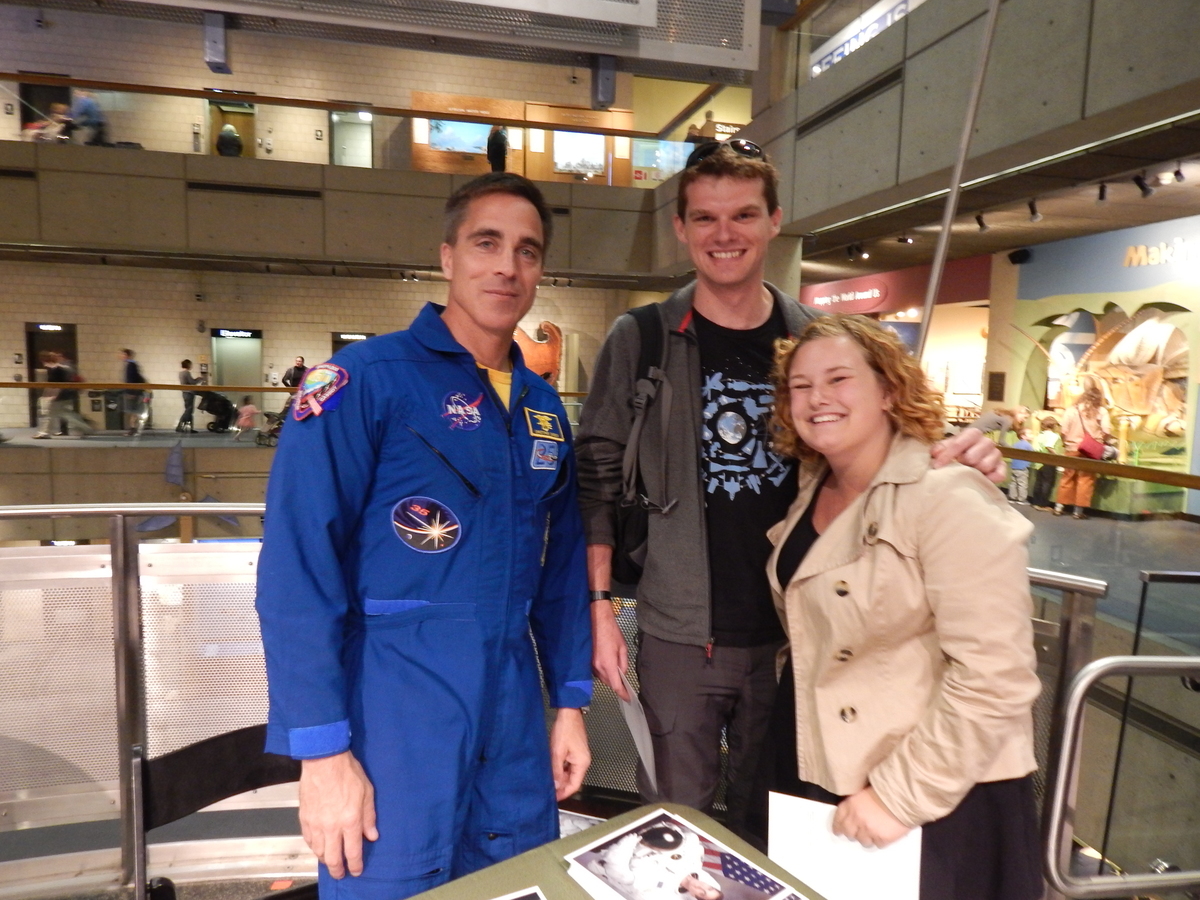
Chris Cassidy is a cool guy. Astronauts, as a rule, seem to be pretty great people, not that I've met more than one, and Chris didn't seem to be any exception. This is a guy who helped shoot Chris Hadfield's Space Oddity video, and conducted an unplanned spacewalk to save the Space Station('s cooling system), and was featured in a certain 30-minute full-dome documentary on astronaut training - and yet here he is patiently, even happily, talking about space toilets to a bunch of kids. Maybe I've been drinking the Astronaut's Guide kool-aid a bit too much, but maybe if we were all a little bit more like astronauts then the world would be a better place.
-
Boston may have a bigger, nicer, more purpose-built building than Scitech, but overall they're pretty comparable. The only thing I am properly jealous of is their uniform, which is (I kid you not) bright red lab coats. Blue polo shirts can suck it. But the exhibits were of similar quality, and the activities were very similar, and apart from a vague wistfulness about their nice building I feel like my job stacks up pretty well.
-
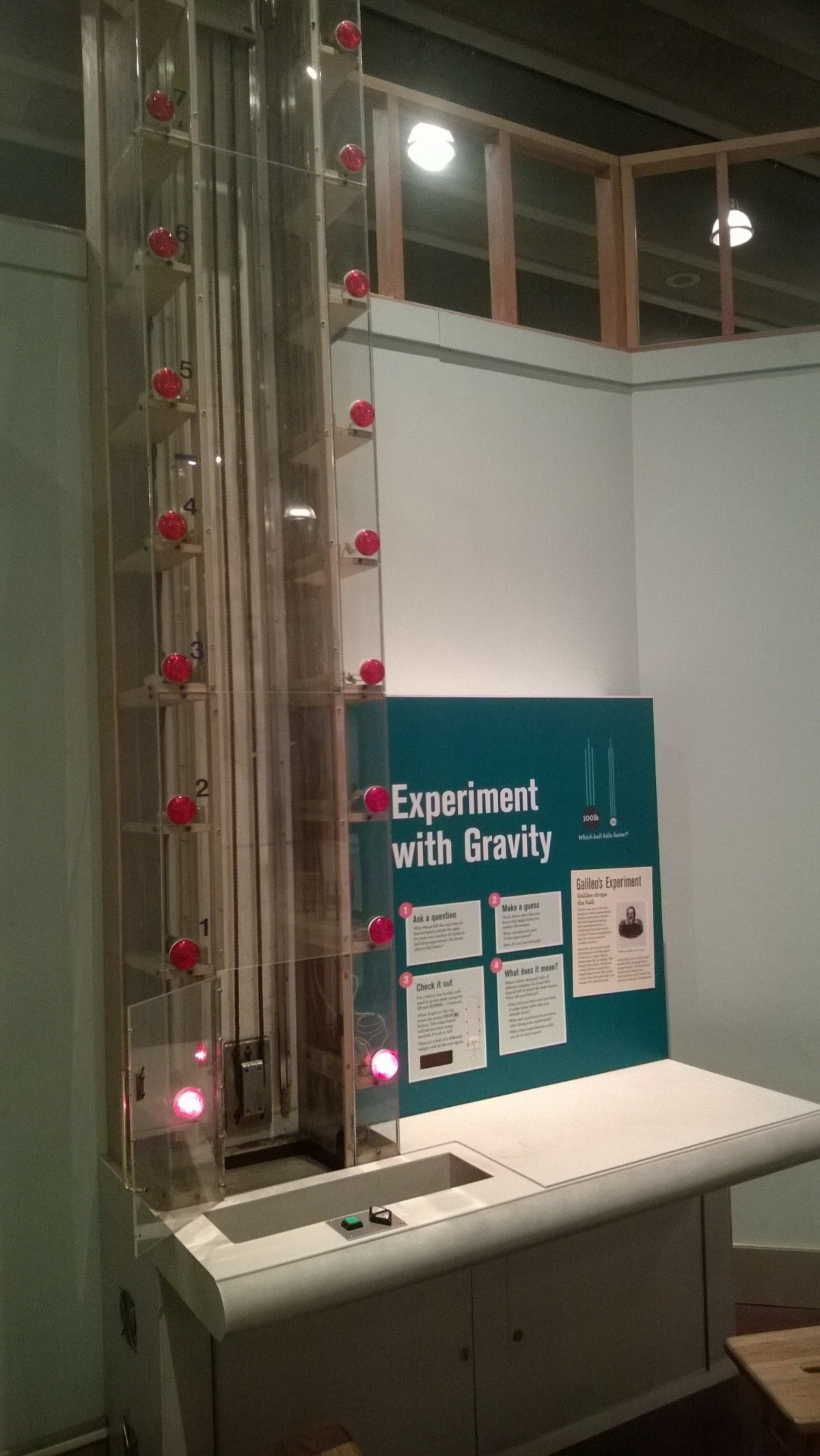
One exhibit I was a little bit jealous of was this guy. It lifts up two identically sized balls of different masses, and lets you drop them from different heights. I think it really elegantly demonstrates a pretty hard-to-explain concept, that accelaration due to gravity ends up the same regardless of mass. And the story of Newton at the Tower of Pisa is pretty interesting, and very important to the history of science to boot. Basically, I'd never considered demonstrating this as an exhibit, and I kinda want one.
-
They had a really cool exhibition on models. Everything from scale models, to working models, to abstract models, to mental models. How we make them, and use them, and how they each have strengths and weaknesses. It was a really illustrative idea for an exhibition, and it's pretty indicative of what you can do if you have enough space to devote to something niche-y like that instead of having to have just one feature exhibiton. I don't think it would do so well at Scitech, but I dig it nonetheless and I'm really glad it exists.
-
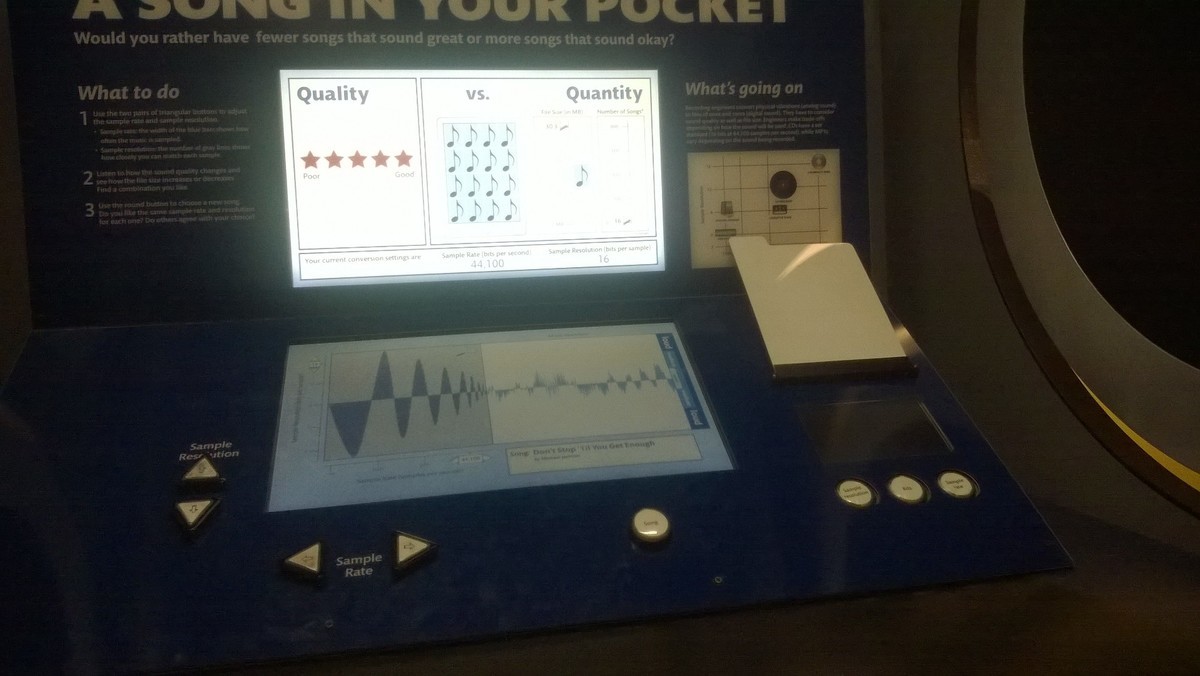
I got a bit of a chuckle out of this one which basically seemed to be 'MIT indoctrinates a generation of kids to become bitrate snobs: the exhibit'. It's a cool way of demonstrating what those pretty opaque-seeming numbers on your files actually mean though, which is a cause I can always get behind.
-
Here's something that I actually learned for myself: Why toilets don't flush properly if you don't let the tank fill all the way up. As illustrated by (and here's a sentence you rarely hear:) a truly wonderful cutaway toilet bowl. Which I didn't photograph, I drew it instead, but I assure you had little red foam balls instead of... anything else.
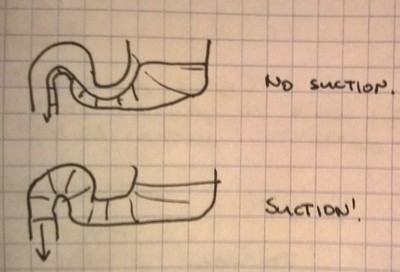
I always assumed it was something to do with the sheer weight of the water, but it looks like it's something a little more subtle. I think you need enough volume of water to create some suction in the S-bend, such that the contents of the bowl aren't pushed down, they're pulled. Without that volume of water, there isn't a clean seal, and thus not enough suction to empty the bowl. At least, I think that's what's happening. It certainly looks that way.
It was definitely fascinating to watch, at any rate.
Wed Apr 22 19:02:56 2015
This might be of interest with regards to the toilet siphon:
http://en.wikipedia.org/wiki/Pythagorean_cup