It was Saturday night. We were two rounds into a game of cards, and Haydn had just been the target of a Filibuster card, requiring him to talk, for one minute, on the topic of 'The Positive Aspects of Magic: The Gathering'
"Well," he began, "It brings people together. In a way which is truly, uh, unique."
(Haydn hated Magic.)
"It is truly, a most effective, method, of increasing the speed with which time passes, and has many strong, social aspects. In conclusion, it can be seen that it really does bring people together."
"You still have half a minute left."
"Aw, crap."
In true filibuster fashion, he managed to continue on much the same tack until his time was up without really saying anything else. He won the points, to not-insignificant applause.
It was not an easy task, by any means. It's difficult to see the positives from outside. From outside, Magic is arcane and impenetrable, a game of silence and stares and intense concentration. From the outside, it looms over conversations, a groaning bastion of jargon and theory and dense meaningless rules, which grinds through time and money like a the kind of very angry overpowered fruit juicer you see advertised on late-night television.
Having spent almost exactly 3 months playing, I can confirm that from the inside it's pretty much the same. And its redeeming qualities, while definitely extant, are not easy to articulate.
The appeal of Magic is the appeal of solving a puzzle. It tickles the same weird part of our monkey-brains that goes crazy for Tetris or jigsaws.
Except instead of playing with blocks, or pieces, you're playing with rules. Every card is a tiny, discretised chunk of rulebook, which interacts with other rules in ways which are not entirely predictable, and often not even known until you pick them up off the top of the deck, or they come out of your opponent's hand. It presents you with an entirely new puzzle space, and an entirely new set of possible solutions, and it does this every single game.
It's a game that understanding strategy and paying attention to details. It rewards the intimate knowledge, not just of your cards, but which cards the opponent is likely to have, given your cards, given their cards, ad infinitum. Above all, it rewards this deep, almost intuitive understanding of the rules and how to plot an optimal path through them.
Historically, this is not something I've been very good at.
Solving Magic optimally just might not be that fun to me. Not least because after a little while it starts to look an awful lot like work. Games are this consequence-free, interactive, richly themed environment. Maybe I prefer to play in them, not solve them. Maybe I'd rather explore something which plays interestingly, or has a cool theme.
And it's not that you can't play Magic like that. It's just that if you do, it's very difficult to actually get anywhere, let alone win.
Here's an example for you. A staple of Magic is including 'answers' in your deck. Like, 'can your deck answer creatures? can it answer counterspells?'. Which, to me, is missing the point. I don't want to have the right answer. I want to face an interesting question, and solve it using the resources at hand. There's a subtle difference.
I want interactivity - I want to be able to do stuff. An answer doesn't afford you anything. There's no choice there. Not for you, and usually not for the other guy. You just answer, and nothing happens. And that's a bit boring.
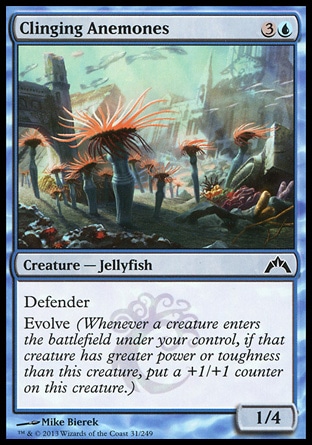
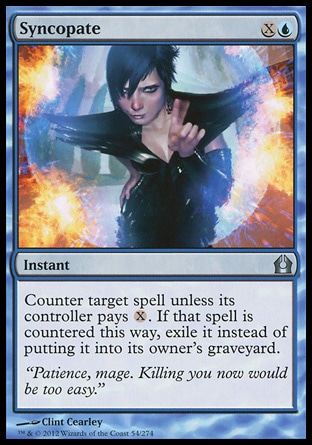
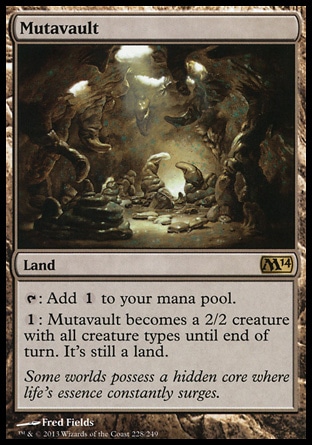
(Not least when your Gothic-themed Doom Blade is mixed up with a motley assortment of jellyfish, anime girls and weird looking space rocks. I mean really. What's the point of playing if you aren't going to do it with style?)
< I fell off my bike. The first Monday of the rest of his life. >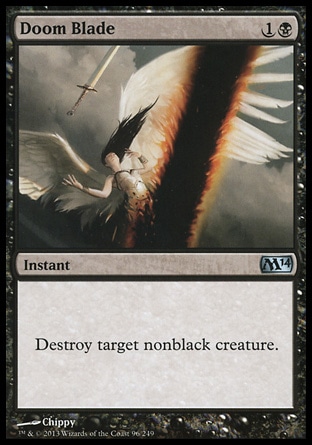
Wed Oct 2 17:47:26 2013
A good read Rockwell. I'd like to add a few points regarding the last few paragraphs.
I agree, Magic does have a lot of variety, you can build fun flavour filled decks, you can build decks that show off how great you are at combining cards in interesting ways, or you can build decks that are the most efficient way to win you can achieve.
I feel that you perception on answers, and the difficulties of playing a flavour based deck has been largely influenced by your primary Magic play group however. Myself being a part of it, it's an easy observation to see that at least 3 members (of roughly seven people) of it are a distinct step above the rest in terms of competitive nature and the amount they value winning above all else in the way they seek to play others outside of their usual play group. This is also reflected in their deck building.
However, all 3 members have a preference for "control" type decks, ones that specialise in having all the "answers" to each possible threat. Because of this, they tend to discuss in terms of answers as opposed to threats and power. Answers are the main focus of these decks, and the power comes from knowing when to use the finite supply of answers. But this is only 1 type of deck. Most decks do not have strict "answers" to anything, other than, "my answer to your little dude, is my much bigger dude". Answers aren't a staple in most decks, only in reactive decks as opposed to proactive decks which in the bigger picture are far more common. But as stated before, this just isn't the kind of deck the people in your group play a lot, so they focus on answers.
In other decks and other situations, solving issues with the resources at hand is the primary action when playing Magic outside of a specific deck archetype. For example, if you are playing someone who is say, playing the colours white and blue and not playing any creatures for the first 4 turns, and may in fact be doing nothing those first turns, then they are quite clearly either really terrible or are going to use a card that destroys all creatures. Assuming you're not at the highest level of competition with money on the line, you shouldn't have an "answer" for that specific threat. But you can easily play around it by not playing out every creature in your hand straight away, play enough creatures to force the issue but not over commit. Being a blue-white player myself, that is the specific type of playing that causes me to lose games against decks that don't have answers, but instead have threats.
On the topic of theme decks, yes, it will have difficulties winning against decks built for winning tournaments. That's just how things happen when people in your play group build decks with very different goals in mind because of what they enjoy about the game of Magic. One solution? Tell people to play theme decks, forget the concepts of formats, just play theme decks against theme decks. If asked, I'm sure a tournament player would still give it their best shot (albeit their adherence to flavour will be much lesser).
tl;dr: I feel your views on the issues of "answers" are very much influenced by the group you play Magic with the most and their preference of decks and playstyle.